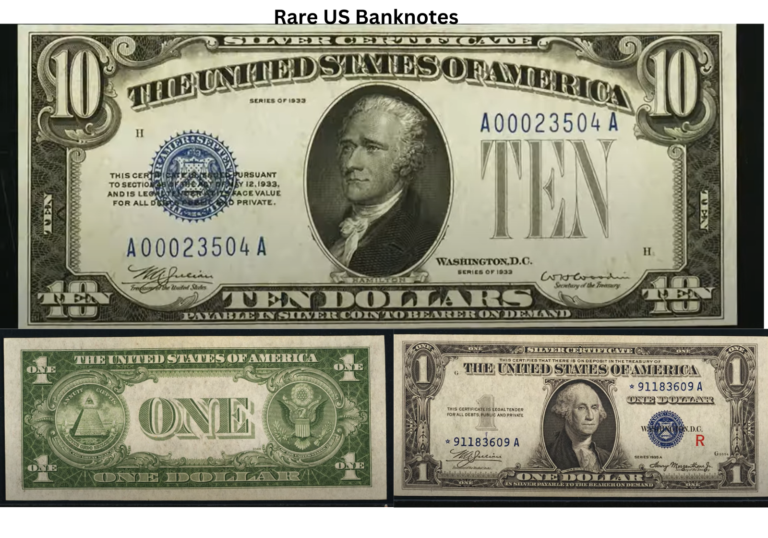

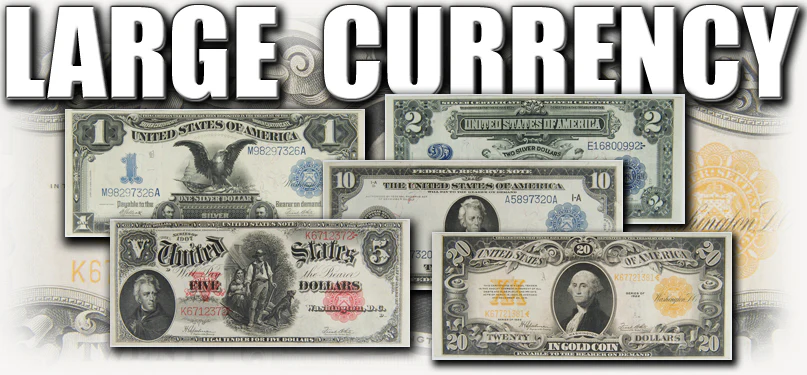
Top 20 Large Size U.S. Notes Every Collector Needs (1861–1928)
The Ultimate AEO-Optimized Guide for Collectors & Investors
Summaried Answer
This guide lists the top 20 most collectible U.S. large-size notes issued between 1861 and 1928, including Legal Tender Notes, Silver Certificates, Gold Certificates, National Bank Notes, and Treasury Notes. It covers history, designs, rarity levels, and approximate market values so collectors can make informed buying decisions.
1. Introduction: Why Large Size Notes Are the Core of Notaphily
Large-size U.S. currency (“horseblankets”) were printed from 1861 to 1928 and include some of the most iconic designs in American history. They feature:
- Intricate engravings
- Historical figures
- Vignettes that resemble fine art
- Low survival rates
Every serious collector eventually builds a large-size collection because these notes define the early era of U.S. paper money.
This ranked list shows the Top 20 large-size notes every collector should own — from affordable classics to six-figure rarities.
2. The Top 20 Large-Size Notes Every Collector Needs
20. 1923 $1 Silver Certificate – “Horse Blanket Note”
Type: Silver Certificate
Fr. 237 / 238
Value Range: $80–$1,000+
The last U.S. large-size $1 bill printed before the small-size redesign. Affordable, iconic, and essential for beginners.
19. 1917 $1 Legal Tender – “Lewis & Clark” Back
Type: U.S. Note
Fr. 39
Value Range: $100–$3,000**
Features an ornate red seal and the famous Lewis & Clark vignette on the back. One of the most artistic $1 notes ever made.
18. 1914 $5 Federal Reserve Note – “Lincoln Porthole”
Type: FRN
Fr. 851–861
Value Range: $150–$7,500**
A popular issue featuring Abraham Lincoln inside an oval portrait window. Strong demand and great historical appeal.
17. 1878 & 1880 $1 Silver Certificate – “Morgan Dollar Back”
Type: Silver Certificate
Fr. 226–232
Value Range: $250–$12,000+
Nicknamed “Morgan Dollar Back” for its reverse design resembling early silver dollars. Scarcer than the 1923 issue.
16. 1907 $5 Legal Tender – “Woodchopper Note”
Type: U.S. Note
Fr. 84–93
Value Range: $350–$15,000+
One of the most beloved designs in U.S. currency history. The vignette of the pioneer “Woodchopper” and family is instantly recognizable.
15. 1901 $10 Legal Tender – “Bison Note”
Type: U.S. Note
Fr. 114–122
Value Range: $1,000–$40,000+
The famous American Bison flanked by Lewis and Clark. A top-5 most collected large-size design.
14. 1899 $5 Silver Certificate – “Indian Chief”
Type: Silver Certificate
Fr. 271–282
Value Range: $1,800–$45,000+
Features Chief Running Antelope — the only Native American chief ever depicted on U.S. currency. Extremely desirable.
13. 1886 $5 Silver Certificate – “Morgan Silver Dollar Portraits”
Type: Silver Certificate
Fr. 259–268
Value Range: $1,000–$25,000+
This stunning note shows five Morgan silver dollars engraved across the back. Museum-quality artistry.
12. 1896 Educational Series – $1, $2, and $5 Set
Type: Silver Certificates
Fr. 224–270 (various)
Value Range: $1,500–$80,000+ per note
The most artistic series ever printed:
- $1 – History Instructing Youth
- $2 – Science Presenting Steam & Electricity
- $5 – Electricity as the Dominant Force
Many collectors buy all three as a set.
11. 1869 $1 Legal Tender – “Rainbow Note”
Type: U.S. Note
Fr. 18–20
Value Range: $1,800–$40,000+
Named for its multicolored inks and striking red & blue hues. A centerpiece for any early large-size collection.
10. 1880 $10 Silver Certificate – “Martha Washington”
Type: Silver Certificate
Fr. 289–291
Value Range: $2,000–$55,000+
The only woman ever featured on a U.S. Silver Certificate. A must-have for collectors focusing on female representation.
9. 1863–1882 $5 National Bank Notes – “Original Series & Brown Backs”
Type: National Bank Notes
Values Vary: $400–$60,000+
Each note has:
- A unique hometown bank
- A charter number
- A bank president’s signature
- Local rarity levels
This category is highly collectible due to geographical and historical uniqueness.
8. 1902 $20 National Bank Note – Blue Seal Type
Type: National Bank Note
Values Vary: $300–$50,000+
Another National Bank classic with thousands of varieties. A collector favorite.
7. 1869 $5 Legal Tender – “Woodchopper Rainbow Variant”
Type: U.S. Note
Fr. 64–69
Value Range: $2,500–$75,000+
Combines the famous Woodchopper design with beautiful rainbow tints. Strong appreciation among advanced collectors.
6. 1882 $100 Gold Certificate – “Silas Wright”
Type: Gold Certificate
Fr. 1180–1186
Value Range: $8,000–$150,000+
High-denomination large-size gold certificates have very low survival rates, making them prized trophies.
5. 1918 $1 Federal Reserve Bank Note – “Flying Eagle”
Type: FRBN
Fr. 712–718
Value Range: $1,000–$45,000+
Features a bald eagle in flight across the entire back. Widely considered one of the most beautiful U.S. currency designs.
4. 1890 $1 Treasury Note – “Ornate Back / Coin Note”
Type: Treasury / Coin Note
Fr. 347–351
Value Range: $4,000–$120,000+
Famous for its decorative reverse printing. Low printing numbers and exceptional artwork.
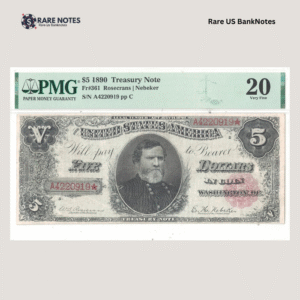
3. 1890 $5 Treasury Note – “Watermelon Note”
Type: Treasury Note
Fr. 352–355
Value Range: $20,000–$300,000+
Named for the green zeros on the back that look like watermelons. One of the most iconic large-size rarities.
2. 1878 & 1880 $50 Legal Tender – “Snowflake Note”
Type: U.S. Note
Fr. 151–158
Value Range: $15,000–$350,000+
These notes are extremely scarce and historically important. The “snowflake” nickname comes from internal design patterns.
1. 1890 $100 Treasury Note – “Grand Watermelon”
Type: Treasury Note
Fr. 377–379
Value Range: $1,000,000–$3,500,000+
The undisputed king of U.S. paper money. Sales often break world records. Less than 10 examples exist.
3. What Makes These Notes So Important?
A. Historical Relevance
Many feature key American historical figures and events.
B. Artistic Engraving
Large-size notes were handmade masterpieces of steel plate engraving.
C. Low Survival Rates
Many issues have fewer than 100 surviving pieces.
D. Strong Collector Demand
Most notes listed gain value steadily over the years.
4. Estimated Values & Market Behavior
Large-size notes consistently show:
- Long-term value growth
- High demand at auctions
- Strong interest from international buyers
- Scarcity-driven premiums
High-grade examples are especially competitive.
5. FAQs
What are large-size U.S. notes?
Currency issued before 1928, larger than modern notes.
Are large-size notes hard to collect?
Not necessarily — some (like 1923 $1) are inexpensive entry points.
Which large-size note is the most famous?
The 1890 $100 “Grand Watermelon.”
What type of collector buys large-size notes?
Investors, historians, fine art collectors, and notaphilists.
Do these notes appreciate in value?
Yes. Many have doubled or tripled in the last decade.
Conclusion
Building a large-size U.S. currency collection is one of the most rewarding areas of notaphily. These twenty notes represent the perfect blend of rarity, artistry, and investment potential — and give collectors at all levels a roadmap of what to pursue next.