

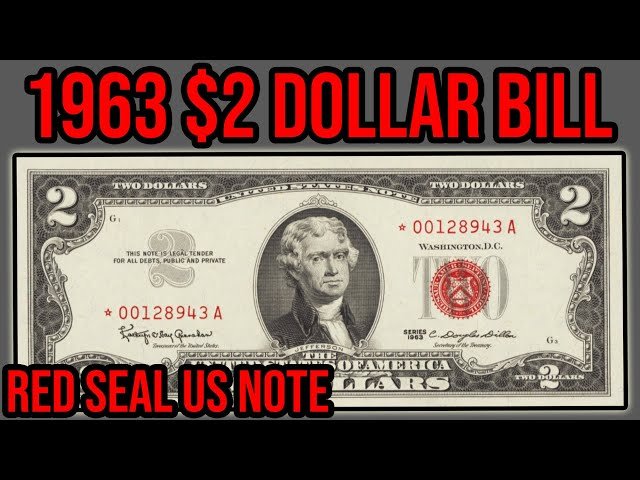
💵 Red Seal $2 Bill Value Guide (1928–1963 Series) — How Much Is Yours Worth?
If you found a Red Seal $2 bill and want to know its value, you’re in the right place.
These notes were printed between 1928 and 1963, featuring the familiar red Treasury seal and red serial numbers. While many are common, certain series, star notes, and high-grade examples can be worth hundreds, even thousands, of dollars.
Quick Answer: What is a Red Seal $2 Bill Worth?
Most Red Seal $2 bills are worth $3 to $15 in circulated grades.
Uncirculated examples can sell for $20 to $80, but rare varieties or star notes from scarce series can be worth much more:
| Series | Common Circulated | Uncirculated | Notes |
|---|---|---|---|
| 1928 | $6–$20 | $60–$250+ | Scarcer, early issue |
| 1928A | $6–$15 | $50–$180 | Affordable |
| 1928B–1928G | $5–$12 | $20–$75 | Most common |
| 1953 Series | $3–$10 | $15–$40 | Very common |
| 1963 Series | $3–$8 | $12–$30 | Most common overall |
| Star Notes | $20–$200+ | $100–$1,000+ | Major premium depending on the series |
The rest of this guide explains how to identify your bill correctly — and how to know if yours is rare.
Understanding Red Seal $2 Bills
Red Seal $2 bills are part of the United States Legal Tender Note series. Unlike modern $2 bills with green seals, these older notes used red ink for both the Treasury seal and serial numbers.
Key features:
- Red seal on the right side
- Red serial numbers
- Portrait of Thomas Jefferson
- The reverse shows Monticello
- Printed from 1928–1963
Collectors love them because of their striking color and the nostalgia associated with pre-1960s U.S. currency.
-
1882 $100 Gold Certificate – Fr. 1215 | PMG 35 EPQ | Rare “Benton” Note
Original price was: $4,275.$3,841.80Current price is: $3,841.80. -
1882 $100 Gold Certificate – Large Size | Very Fine Condition
Original price was: $854.05.$811.35Current price is: $811.35. -
1907 $5 Legal Tender Woodchopper Note | Fr. 91 | Large Size Red Seal
Original price was: $217.80.$196.02Current price is: $196.02. -
1922 $100 Gold Certificate FR.1215 (RARE Issue RARE Grade) PCGS AU-55
Original price was: $6,935.$6,269.05Current price is: $6,269.05.





Full Value Guide by Series (1928–1963)
Each series has different rarity levels, printing quantities, and collector demand. Below is a breakdown for every major series.
🔴 1928 Red Seal $2 Bill Value
The 1928 issue is the original and scarcer than later releases. Values are higher.
⭐ Value:
- Circulated: $6–$20
- About Uncirculated: $30–$80
- Uncirculated: $60–$250+
- Star Notes: $150–$1,000+ depending on grade
Why it’s valuable:
- First small-size Legal Tender $2 bill
- Lower print run
- Early red seal collectors pay premiums
🔴 1928A Red Seal $2 Bill Value
A bit more common than the 1928, but still desirable.
⭐ Value:
- Circulated: $6–$15
- Uncirculated: $50–$180
- Star Notes: $100–$600+
🔴 1928B–1928G Red Seal $2 Bill Values
These are the most common Red Seal $2 bills from the early years.
⭐ Value:
- Circulated: $5–$12
- Uncirculated: $20–$75
- Star Notes: $50–$250+
These are often found in average condition, so high-grade notes bring strong premiums.
🔴 1953 Series $2 Bill (1953, 1953A, 1953B, 1953C)
Very common — millions printed.
⭐ Value:
- Circulated: $3–$10
- Uncirculated: $15–$40
- Star Notes: $25–$120+
These are the most frequently encountered Red Seals today.
🔴 1963 Red Seal $2 Bill Value
The final red seal issue before the government switched entirely to green seals.
⭐ Value:
- Circulated: $3–$8
- Uncirculated: $12–$30
- Star Notes: $25–$100+
These are the least valuable, but also the most collected, because they’re a popular “first collectible banknote.”
Star Notes: The Hidden Jackpot
If your Red Seal $2 bill has a ★ (star symbol) at the end of its serial number, it’s a replacement note — and collectors pay premiums for these.
How to identify a star note:
- Look at the right side serial number
- If it ends with a ★, you have a star note
Value Range:
- Common stars: $20–$60
- Scarce stars (1928 series): $150–$1,000+
- High-grade stars: can exceed $2,000
Star notes are often worth more than regular notes, even in low grade.
How to Tell If Your Red Seal $2 Bill Is Rare
Check for the following:
✔ 1. Series year
Earlier series = more value.
1928 > 1953 > 1963
✔ 2. Condition (Grade)
Uncirculated notes bring the highest prices.
Crisp, no folds = large premium.
✔ 3. Star note
Star = instant collector premium.
✔ 4. Low or fancy serial numbers
These can add $10–$5,000, depending on rarity.
✔ 5. Printing district & plate numbers
Scarce combinations increase value.
Rarest Red Seal $2 Bills
These varieties consistently bring strong prices:
- 1928 Star Notes
- 1928B Star Notes
- Low serial numbers (#00000001 – #00000999)
- Gem Uncirculated 66–68 EPQ/PPQ grades
If you own one of these, it’s worth getting graded by PMG or PCGS Banknote.
Should You Get Your Red Seal $2 Bill Graded?
Grading is recommended if your note is:
- Uncirculated
- A star note
- 1928 or 1928A series
- Rare serial number
- High-value error
A graded note can increase value by 50% to 500% depending on the condition.
Where to Sell a Red Seal $2 Bill
Best places to sell:
- Rareusbanknotes.com
- eBay
- Collector forums
- Facebook currency groups
- Heritage Auctions (for high-end pieces)
- Stack’s Bowers
For average notes, online marketplaces work best.
For rare stars or high-grade notes, auction houses can maximize your sale price.
Frequently Asked Questions
Are Red Seal $2 bills rare?
Most are common, but early series and star notes can be quite rare.
Can banks give you Red Seal $2 bills today?
No — these are no longer issued.
Are Red Seal bills still legal tender?
Yes, all U.S. currency remains legal tender, regardless of age.
Is a torn or damaged Red Seal bill still valuable?
Yes, but the condition affects the price.
Heavily damaged notes usually trade at $2–$4.
What’s the most valuable Red Seal $2?
The 1928 star notes — some examples exceed $2,500.
-
1899 $1 Silver Certificate – Large Size | Blue Seal | “Black Eagle”
Original price was: $616.55.$578.55Current price is: $578.55. -
1899 $2 Large Size Silver Certificate – Blue Seal | Uncirculated
Original price was: $1,501.$1,330Current price is: $1,330. -
1899 $2 Silver Certificate – “Mini Porthole” | PMG 25 | Bright & Attractive
Original price was: $712.50.$624.15Current price is: $624.15. -
1899 $2 Silver Certificate – Mini Porthole | Fr.256 | PCGS-Certified
Original price was: $503.50.$478.33Current price is: $478.33.


Conclusion
Red Seal $2 bills are some of the most popular collectible banknotes in the U.S. market. While many are common, certain series — especially early 1928 issues and star notes — can be valuable.



One Comment