
Complete Guide to U.S. National Bank Notes (1875–1935)
Summary (Direct answer)
This guide explains what U.S. National Bank Notes are, how they were issued, the different types (Original Series, Brown Backs, Blue Backs, Red Seals, and 1902–1929 types), how to identify rarity, how charter numbers work, and how collectors can determine values. Covers history, grading, and investment strategies for building a high-value National Bank Note collection.
1. Why U.S National Bank Notes Are a Collector Favorite
National Bank Notes were issued from 1863 through 1935 by thousands of local banks across the U.S. Unlike federal currency, these notes:
- We were backed by individual banks
- Carried the name of the town
- Displayed unique charter numbers
- Often had low printing quantities
This makes National Bank Notes one of the most historically rich and collectible categories in all of notaphily.
Every note has its own story — sometimes tied to ghost towns, failed banks, or early American settlements.
2. What Are U.S. National Bank Notes?
National Bank Notes were produced under the National Banking Act of 1863.
Local banks deposited bonds with the U.S. Treasury, and in return, they received sheets of currency printed with:
- The bank’s city and state
- A unique charter number
- The bank president’s & cashier’s signatures
- Distinctive seal colors depending on the series
These notes were technically federal currency, but locally branded.
3. Why Collectors Love National Bank Notes
1. Geographic Collectibility
Collectors often try to build sets from:
- Their home state
- Their hometown
- Historical territories
- Ghost towns and closed banks
2. Rarity by Bank
Some banks printed:
- Only a few thousand notes
- Some, only a few hundred
- Some printed only one issue before failing
3. Artistic Engraving
Early issues display intricate vignettes and steel engraving unmatched today.
4. Investment Strength
Notes from rare towns or low populations steadily increase in value.
4. The Major Types of National Bank Notes (1863–1935)
Below is the complete breakdown collectors use to categorize and value notes.
A. Original Series (1863–1875)
Seal: Large Red Treasury Seal
Charter Numbers: 1–3254
Back Color: Green or Black
Values: $500–$40,000+
These are the first-ever National Bank Notes. They are extremely scarce due to Civil War era use and low survival rates.
B. 1875 Issue – “Red Seal Nationals”
Seal: Small Red Treasury Seal
Charter Numbers: 1–4799
Values: $400–$25,000+
Features bold red seals and serials. These were printed in limited numbers, and most were redeemed.
C. Series of 1882 – Brown Backs, Date Backs, and Value Backs
These are among the most collectible large-size nationals.
1. 1882 Brown Backs (Most Sought After)
Values: $600–$40,000+
- Large brown back design
- Early state and territorial banks
- Several towns are known by only 1–2 notes
2. 1882 Date Backs
Values: $300–$12,000+
- Smaller back design with printed dates
- Often more affordable
3. 1882 Value Backs
Values: $300–$15,000+
- Back printed with the denomination spelled out
- Harder to find in high grade
D. Series of 1902 – Red Seals, Blue Seals, and Plain Backs
These are the most commonly collected large-sized nationals.
1. 1902 Red Seal
Values: $700–$35,000+
Very popular due to the striking red seal and early print dates.
2. 1902 Blue Seal – “Most Common Type.”
Values: $200–$10,000+
Issued in huge numbers by thousands of banks.
3. 1902 Plain Back
Values: $150–$7,000+
Common, but rare towns still command steep premiums.
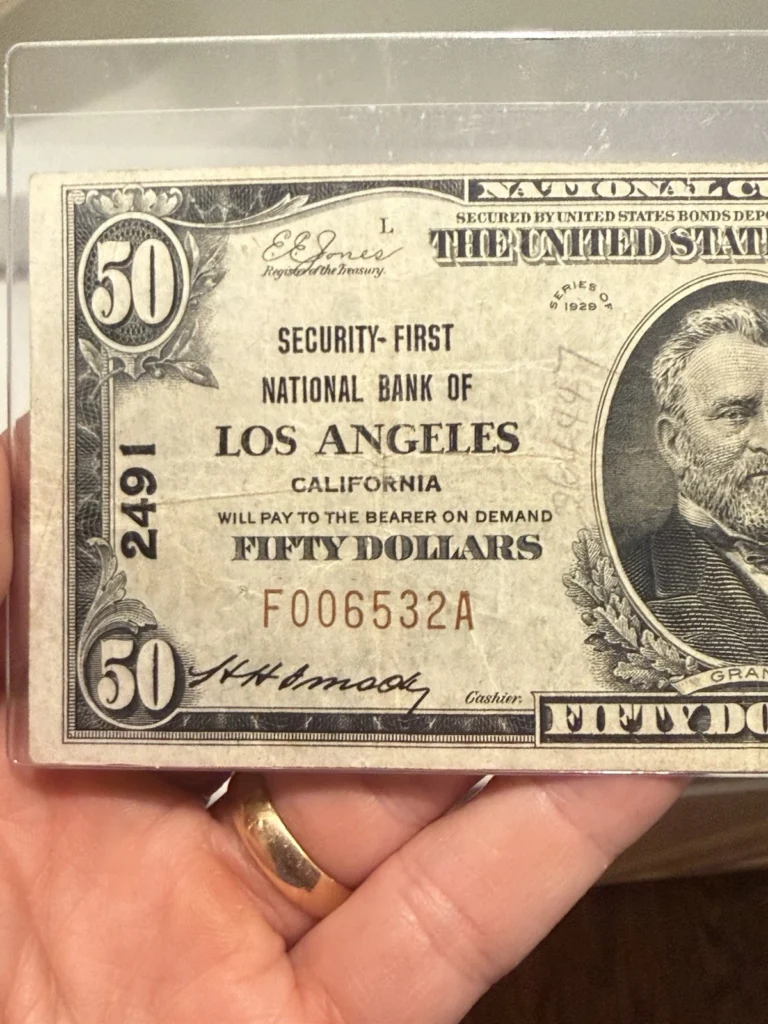
E. Series of 1929 – Small Size Nationals
Type 1 & Type 2
Values: $40–$4,000+
While not large-sized, these are part of the National Bank Note family. Collectors often look for:
- Rare towns
- Low populations
- Short-lived banks
5. How Charter Numbers Work (The Key to Understanding Rarity)
Every Guide to U.S. National Bank Notes includes a charter number, printed multiple times:
- On the front in large numerals
- Inside the Treasury Seal
- In small backgrounds
- On the bank plate
What the Charter Number Tells You:
- The bank’s founding sequence
- The region and state
- Whether the bank had predecessor or successor banks
- How long has the bank survived
- How many notes does the bank issue
For example:
- Charter 100 = Very early, Civil War era bank
- Charter 12,000+ = Late, 1920s bank
Early charters typically bring higher premiums.
6. What Determines the Value of National Bank Notes?
1. Town Population & Rarity
Low population = low print numbers.
Many collectors chase:
- Wild West towns
- Mining camps
- Ghost towns
- Rural Southern towns
- Pre-statehood territories
2. Bank Longevity
Banks that failed early printed fewer notes.
3. Type of Note
Red Seals and Brown Backs command the highest premiums.
4. Condition (Grading)
Even a Fine 12 from a rare town can sell for thousands.
5. Serial Numbers & Plate Letters
Low serial or unique plates influence price.
6. Demand from Collectors
Some states (like California, Texas, and Colorado) are heavily collected, increasing value.
7. States with the Most Valuable National Bank Notes
Some states are extremely competitive among collectors:
Top-Tier Rarity States
Mid-High Rarity
- Colorado
- Montana
- Idaho
- Utah
High Population but High Demand
- Texas
- California
- New York
-
1899 $1 Silver Certificate – Large Size | Blue Seal | “Black Eagle”
Original price was: $616.55.$578.55Current price is: $578.55. -
1899 $2 Large Size Silver Certificate – Blue Seal | Uncirculated
Original price was: $1,501.$1,330Current price is: $1,330. -
1899 $2 Silver Certificate – “Mini Porthole” | PMG 25 | Bright & Attractive
Original price was: $712.50.$624.15Current price is: $624.15. -
1899 $2 Silver Certificate – Mini Porthole | Fr.256 | PCGS-Certified
Original price was: $503.50.$478.33Current price is: $478.33.


8. Famous Rare National Bank Notes
1. The Goldfield, Nevada Notes
Population boomed during the gold rush, then collapsed — notes are extremely scarce.
2. Tombstone, Arizona Notes
Wild West legends like Wyatt Earp make these highly desirable.
3. Deadwood, South Dakota Notes
Printed in tiny numbers — iconic frontier history.
4. Fairbanks, Alaska Notes
Issued before Alaska became a state — huge premiums.
5. St. Louis “Territory Issue” Notes
Important territory-era banking history.
9. How to Build a National Bank Note Collection (Beginner–Expert)
Beginner Level:
Start with:
- 1902 Blue Seals from common banks
- 1929 Type 1 notes
Intermediate Level:
Move to:
- Red Seals
- Brown Backs
- Scarce towns in your home state
Advanced Level:
Focus on:
- Original Series
- Territorial banks
- Ghost town issues
- High denominations ($50, $100)
10. Authentication Tips for National Bank Notes
Counterfeits exist, especially altered signatures and fake towns.
Check for:
- Correct charter number format
- Matching town name fonts
- Original ink flow
- Correct plate signatures
- No cut-and-paste repairs
- PMG or PCGS certification
11. Quick FAQs
What makes National Bank Notes valuable?
Rarity by town, type, and condition.
Are National Bank Notes a good investment?
Yes — limited supply and high demand drive consistent appreciation.
Which types are the rarest?
Original Series, Brown Backs, and early Red Seals.
How many National Banks issued notes?
Over 12,000 — creating thousands of collectible varieties.
Should I buy graded or raw notes?
For rare towns or high values, graded is recommended.
1899 $1 Silver Certificate – Large Size | Blue Seal | “Black Eagle”
Original price was: $616.55.$578.55Current price is: $578.55.1899 $2 Large Size Silver Certificate – Blue Seal | Uncirculated
Original price was: $1,501.$1,330Current price is: $1,330.1899 $2 Silver Certificate – “Mini Porthole” | PMG 25 | Bright & Attractive
Original price was: $712.50.$624.15Current price is: $624.15.1899 $2 Silver Certificate – Mini Porthole | Fr.256 | PCGS-Certified
Original price was: $503.50.$478.33Current price is: $478.33.
Conclusion Guide to U.S. National Bank Notes
National Bank Notes combine American history, rarity, geography, and artistry all in one collectible category. Whether you’re collecting your home state or chasing legendary ghost-town issues, these notes offer some of the best long-term value and storytelling potential in all of U.S. currency collecting.