

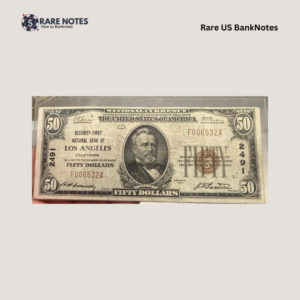
1929 National Currency $50 – Security First National Bank of Los Angeles, California | Charter #2491
The 1929 $50 National Currency Note issued by the Security First National Bank of Los Angeles, California (Charter #2491) is a powerful and highly collectible piece of American banking and currency history. As one of the largest denominations issued under the National Banking System, this note represents both financial prestige and the golden age of regional American banking.
National bank notes from California are especially desirable, and high-denomination examples like the $50 are far scarcer than their $10 or $20 counterparts. For collectors of U.S. paper money, West Coast banking history, or high-denomination nationals, this note is a major rarity.
What Is a 1929 National Currency Note?
The Series of 1929 marked the final issue of U.S. National Bank Notes, printed after the federal banking system was reorganized following the creation of the Federal Reserve. Unlike earlier large-size nationals, 1929 notes were issued in small size, making them easier to handle and store.
Each National Currency note was issued by a specific local bank, with the name of the bank and its unique charter number printed directly on the face.
This means every note is a direct artifact of an individual American bank, not just the federal government.
Security First National Bank of Los Angeles – Charter #2491
The Security First National Bank of Los Angeles was one of the most powerful financial institutions in the western United States during the early 20th century. It played a major role in financing:
- California real estate growth
- Hollywood and the film industry
- Industrial expansion in Southern California
Charter #2491 identifies this exact bank and allows collectors to track:
- Original issuance quantities
- Known surviving examples
- Historical banking data
Los Angeles chartered banks are especially collectible due to their role in the economic explosion of the American West.
Why the $50 Denomination Is So Rare
In National Currency, most notes were printed as:
- $10 and $20 (common)
- $5 and $100 (scarcer)
- $50 (rare)
Banks ordered very few $50 notes because:
- They were mainly used for business and wholesale trade
- High risk of theft
- Limited public demand
As a result, $50 National Notes from any bank are scarce, and those from major banks like Security First National Bank are even more desirable.
Design Features
- Portrait of Ulysses S. Grant on the face
- Bold “National Currency” text
- The issuing bank’s name and Charter #2491 are prominently displayed
- Green Treasury seal and serial numbers
- Ornate engraving typical of 1920s U.S. currency
Collector Value & Market Demand
The estimated value depends on grade and eye appeal:
| Condition | Typical Value |
|---|---|
| Fine | $1,200 – $2,000 |
| Very Fine | $2,500 – $4,000 |
| Extremely Fine | $5,000 – $8,000+ |
| Uncirculated | $12,000+ |
California national bank notes—especially high denominations—are among the most aggressively collected in the hobby.
Why This Note Is So Desirable
- Rare $50 denomination
- Issued by a major Los Angeles bank
- Charter-tracked historical artifact
- Final generation of National Currency (1929)
- Strong demand from U.S. and California collectors
Final Summary
The 1929 $50 National Currency note from Security First National Bank of Los Angeles, Charter #2491, is one of the most impressive regional banknotes ever issued in the United States. Combining high denomination, California origin, and national bank pedigree, it is a premier collector’s piece with both historical and investment significance.